
Vegetable Stock from Scraps
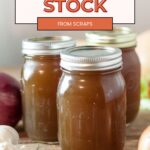
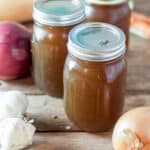
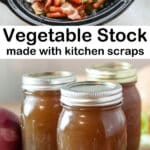
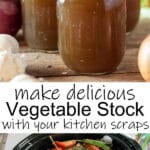
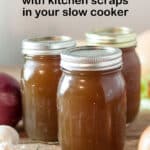
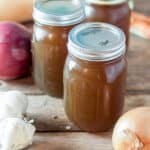
Vegetable Stock from scraps couldn’t be easier! Just save your leftover kitchen scraps! So flavorful and healthy! A great way to reduce your food waste, as well! Freeze for at least 6-8 months in freezer bags!

Waste not, want not. How many times did I hear this growing up? Countless! Making your own Vegetable Stock from Kitchen Scraps is a perfect way to utilize perfectly good ingredients that would have ended up in a landfill!
I saw this idea on Pinterest whilst scrolling through looking for new inspiration a few years ago.
Funny story. When I mentioned it to my Mother, her response was, “Oh Julia (Child) used to do that years ago!” (In her haughty tone! 🙂 ) Of course she did. Julia pretty much did it all, didn’t she?
What you need
- kitchen vegetable scraps
- water

What scraps to use
- onion skins and ends
- leek ends and dark green leaves
- garlic cloves skins and ends
- celery leaves and ends
- carrot peels and ends
- pea pods
- broccoli stems
- zucchini or summer squash ends
- corn cobs
- bell peppers
- eggplant ends
- green beans ends and pieces
- asparagus ends
- cabbage ends & leaves
- Swiss chard, spinach, kale stems, arugula and other leafy vegetables
- Brussels sprouts ends & outer leaves
- potato skins
- mushroom ends
- tomato cores
- pepper cores
- turnip peels
- butternut/ acorn squash peels
- pumpkin peels
- squash ends and seeds
- any fresh herbs or leaves, like thyme, sage, parsley, basil
- bay leaves
- peppercorns
- salt – you can add salt now or just add salt when you use the stock.

How to save scraps for using
Anyway, to make this vegetable stock, just save all of the small ends, skins and stems from the vegetables you are using for your meal preparation. I just put them all in a plastic gallon freezer bag.
Every time I have new scrap to add to the bag, I pull it out and then pop it right back in the freezer.
Once the bag is full, just throw all of the scraps in your crockpot or a large stock pot on the stove (cook for 1-2 hours on stove) and barely cover with water.
Let them cook on low for about 5 hours. Strain the solids from the stock. Then place the stock in freezer bags, or jars and use it in all of your favorite dishes!

Pro Tip; Do not use too many of the very strong vegetables in one batch. Such as; Brussels sprouts, broccoli, turnip, beets. Also don’t use very strong herbs in too great quantities, or it will overpower the stock. Such as; rosemary, sage, thyme, cilantro, etc.
How to make it
- Place frozen scraps in slow cooker. Cover with water.
- Turn on slow cooker. Cook low setting for about 5 hours.
- Strain solids through a fine mesh sieve or use a slotted spoon to remove.
- Discard the solids. I add them to my compost pile.

How to make it on the stovetop
- Place scraps in large Dutch oven.
- Bring to boil.
- Reduce heat to simmer.
- Simmer about 2 hours, until scraps are soft and stock has a nice color.
- Strain solids. Discard. (I add them to my compost pile.) Store in jars in refrigerator or freeze in freezer containers.
Since every batch will have different scraps in different quantities, every batch will be different. I have done this stock for many years and have never had a batch that I didn’t like.
It’s great to be able to pull a bag out of the freezer to substitute for the water or chicken stock that I normally use! It stores in the refrigerator, in sterile pint canning jars, for several weeks, as well.
How to store it
You can place cooled stock in freezer bags and freeze for close to a year. Store it in the refrigerator for at least a week, or two.
To pressure can this stock, follow instructions in this recipe. If pressure canned, it will be shelf stable for at least 12 months
What to do with it?
Use your stock in soups, stews, rice dishes, potatoes, gravy, anything you would normally use stock in.

Recipes to use it in
Have you ever made Vegetable Stock from Kitchen Scraps? It is so easy, you should really give it a try! Then let me know what you think!!
If you grow your own produce, you will have lots of scraps! Learn how to plant a garden in our How to Start a Garden Series!
The first part is Planning Your Garden! Second is Preparing the Garden Site.
The third is Choosing Plants and Planting Your Garden.
The fourth is Garden Maintenance, and the last is Harvesting a Garden and Preserving the Harvest, this post has over 100 FREE recipes for preserving your harvest!
Enjoy! And have fun cooking!


Vegetable Stock from Kitchen Scraps
Ingredients
- 1 gallon bag various vegetable scraps
- 1 various herbs
- 6 cups water, to cover
Instructions
- Label a gallon freezer bag. Every time you make a dish and have vegetable scraps, add them to bag.
- When bag is full, add vegetable scraps to 6 qt. crock pot or a dutch oven. Brussels sprouts stems, onion and garlic skins and ends and sweet pepper stems and seeds.
- Next, I usually clean out the vegetable drawer of any older vegetables. Asparagus ends, 1/2 of an onion that was old (but not rotted) and some baby carrots that have seen better days.
- Add any herbs that you have in the vegetable drawer, as well. Here I added thyme and sage.
- Add water just to barely cover. Cook on low for 5 or 6 hours or on high for 1 to 2 hours.
- Strain solids from the stock through a colander. Discard scraps. Use right away or place in freezer bags and freeze. The stock will freeze for many months.

 See all of my favorite tools and gift ideas on my New Amazon Store!Check out Binky's Amazon Store!
Notes
- onion
- garlic
- cauliflower
- brussels sprouts
- broccoli
- carrots
- celery
- parsnips
- squashes
- parsley
- thyme
- sage
- rosemary
- oregano
Nutrition
Originally published 2/27/2018 Last updated 6/1/2020


I add a couple of corn cobs to mine. So much better than store-bought.
Corn cobs are a great addition! It is so much better.
This is my first time searching Pinterest for veggie scraps! I was so glad to fond your post. I have been doing this for many years and I love the fact that through saving and I can create such awesome stock.
I added a little twist though, I save in separate bags different veggie scraps.
I find it gives me more control for the various flavours.
My largest bag is for onions (no peels) , garlic, peas/ yellow or green wax beans.
And other separate bags for broccoli/cabbage/cauliflower and the like, another for the tomatoes (this one ends up being a few medium size bags) , another for asparagus etc.
It’s easy ,so economically smart and nutritious!
PS, I also freeze roasted chicken leftovers!
I don’t freeze in separate bags, but I don’t add too many of the brassicas like cauliflower, broccoli and brussels sprouts. Large quantities they can be overpowering. I too save chicken scraps for broth. Thanks for checking out the recipe Nicole.